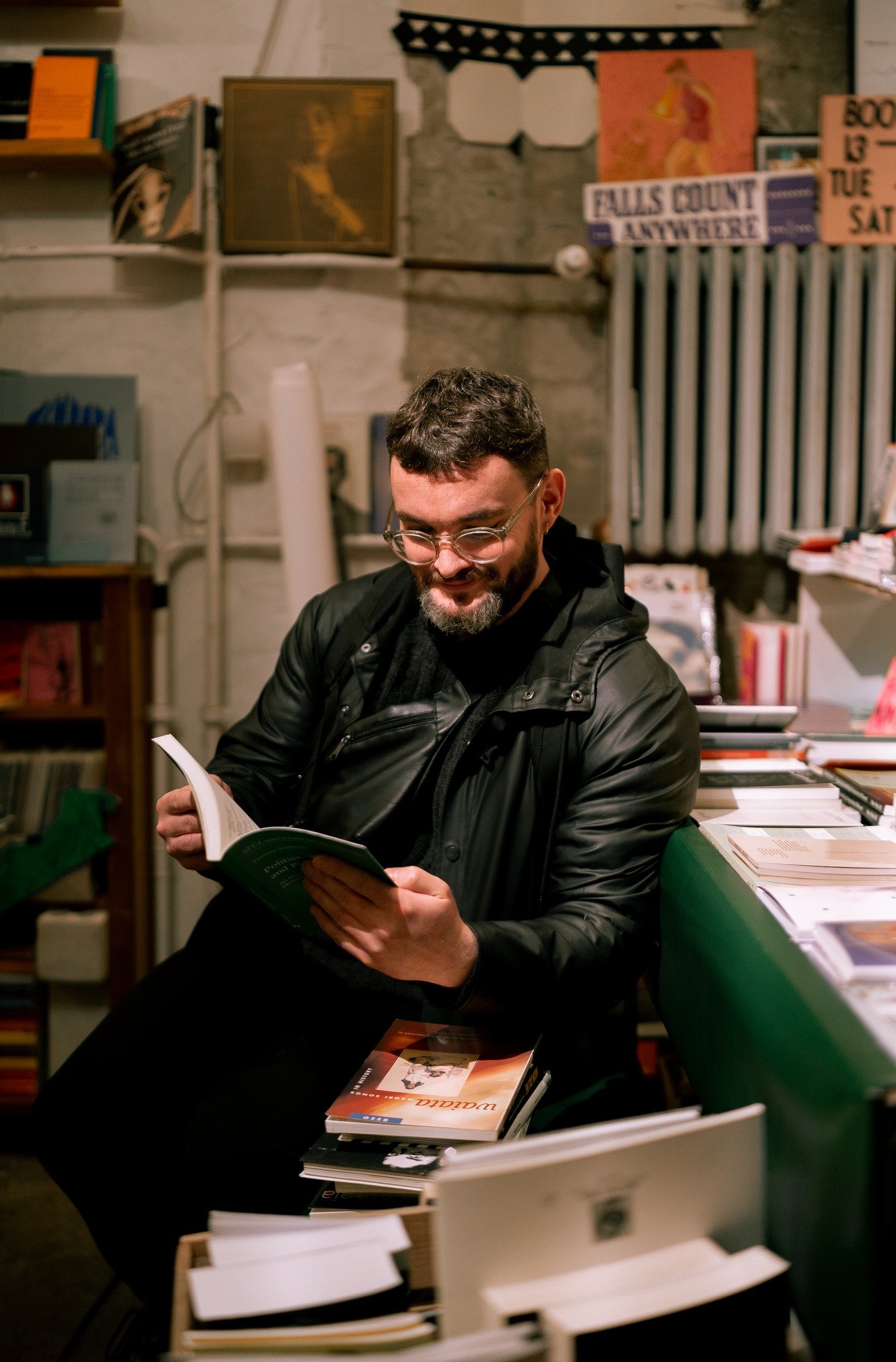
Dr. Eoin Ó Cuinneagáin is a decolonial thinker, researcher and an oral song practitioner.
He is a Postdoctoral Fellow based at the School of Trans-Disciplinary Research and Graduate Studies (STRGS) at the University of South Africa (UNISA), investigating Irish-language indigenous methodologies and their coalitional engagements with other autonomously-voiced indigenous perspectives.
He completed his PhD at Linnaeus University, Sweden under the advisement of Dr. Barzoo Eliassi, Prof. Madina Tlostanova and Prof. Lillis Ó Laoire.
His PhD thesis concerned the oral singing practice of amhránaíocht as a disobedient epistemology. Placing amhránaíocht in non-hierarchical dialogue with other indigenous ways of knowing he proposes the concept of songing as a decolonial methodology of intervention.
Photography by Kevin Settee
Links to Publications
Cancionar como metodología de intervención decolonial: Amhránaíocht y desobediencia epistémica gaélica
Estudios Artísticos, 2026, 12(21), 41–56.
Resumen
Este artículo propone cancionar como una metodología de intervención decolonial, derivada de la práctica oral gaélica de la amhránaíocht y articulada en diálogo con debates latinoamericanos sobre investigación-creación y epistemologías del Sur. A través de la puesta en relación entre prácticas cosmosonorosas, como el yoik y el cante-gitano, el artículo argumenta que los marcos anglo-modernos han reproducido jerarquías epistémicas anglocéntricas que operan para obstaculizar y despotenciar la descolonización-decolonialidad del saber. Frente a este impase, el texto se apoya en pensadores indígenas gaélicos para realinear el pensamiento decolonial con una epistemología relacional, oral y situada. Cancionar se presenta así no como un objeto estético, sino como una práctica metodológica que interrumpe la lógica extractiva del conocimiento anglo-moderno y habilita formas de investigación basadas en la relacionalidad y la sanación. Esta propuesta se sitúa en el marco de la investigación artística y transdisciplinaria, en diálogo con pensamiento del Sur Global.
Palabras clave: Cancionar; desobediencia epistémica; descolonización-decolonialidad del saber; gaélico irlandés,
Sounding Irish-Kurdish-Circassian Relationalities: Affirming Pluritopic, Imparative Methods
Postcolonial Interventions: An Interdisciplinary Journal of Postcolonial Studies, 2026, XI(2), 14–27.
Abstract
This article proposes a relational, pluritopic approach to coloniality through an interimperial reading of Irish, Kurdish, and Circassian histories of struggle. Drawing on decolonial thinking and oral epistemologies, it foregrounds the role of sonorous practices, including Irish-language song, Kurdish dengbêj performance, and Circassian dzeguako traditions, as epistemic practices of resistance. The article argues that dominant anti-colonial and anti-imperial narratives often obscure the experiences of communities whose histories do not align neatly with Eurocentric or statist frameworks, particularly those positioned ambiguously within or at the edges of Europe and West Asia. By tracing the circulation of colonial technologies, logics, and racial discourses across British and Russian imperial formations, the article develops an “imparative” methodological orientation that resists monolithic historiography and instead attends to interconnected, co-constituted histories of domination. Through this relational lens, the article demonstrates how colonial powers, despite apparent geopolitical opposition, collaboratively produce and refine techniques of control and erasure across different sites. In bringing these histories into dialogue, the article advances a pluriversal understanding of coloniality that centres the epistemic autonomy of subjugated communities and highlights the ongoing importance of oral and sonorous traditions in resisting historical erasure and sustaining decolonial horizons.
Keywords: Pluritopic, imparative hermeneutics; coloniality; Kurdish studies; Circassian genocide; Irish studies
The Darker Side of Jonathan Swift: On the Coloniality of Being in A Modest Proposal (1729)
Estudios Irlandeses, Special Issue 18.2, 2023, 11-27.
Abstract
This article reads A Modest Proposal from the darker side of the westernised/anglicised Enlightenment. Firstly, it critically engages with the proclivity within the Anglocentric academy to celebrate English language literary figures associated with “The Enlightenment” in Ireland without a questioning of their role in the colonial project and in shaping its discourses of racism and sexism. Secondly, it focuses on how, from an Irish decolonial perspective, Jonathan Swift can be understood as a manager of the colonial racial/patriarchal matrix of power. Thirdly, it argues that the satire written by Jonathan Swift should be understood as an Anglocentric geo-cultural category and may be understood as westernised/anglicised Enlightenment satire. Finally, A Modest Proposal is analysed in terms of the exceptionality principle of irony, Swift’s project of improvement and salvation of the colonised, and modernity/coloniality’s rhetorical promise yet inability to solve the problems it produces.